
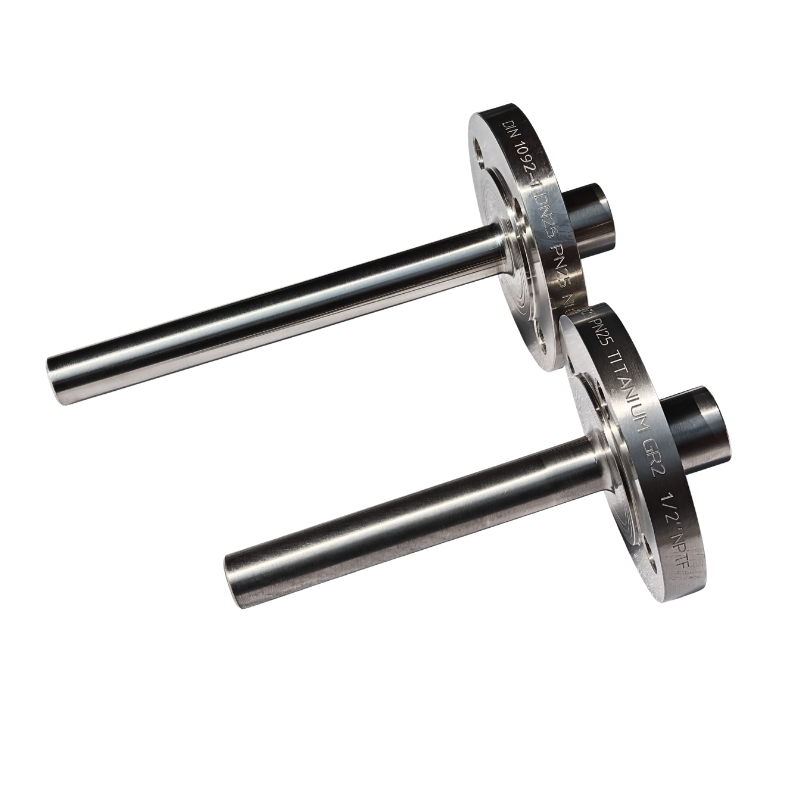
Quick Answer: A thermowell does not have a single market price because the cost is determined by four primary variables: connection type, material of construction, dimensional complexity, and required documentation. Threaded thermowells in carbon steel sit at the bottom of the cost range, while flanged thermowells in exotic alloys such as Hastelloy or Monel with full ASME PTC 19.3 TW-2016 verification can cost orders of magnitude more . Lead time follows the same logic: a stock threaded thermowell may ship from inventory, while a custom solid-drilled flanged thermowell in a special alloy with third-party material certification typically requires weeks of machining and documentation time. Procurement decisions made on unit price alone routinely overlook the cost of a failed wake frequency calculation or a material certificate that arrives after installation.
Key Takeaways:
- Connection type is the largest single cost driver: threaded thermowells range broadly lower than flanged or vortex designs, with flanged thermowells in standard stainless steel occupying the mid-range and special-alloy flanged units at the upper end .
- Material availability, not just material grade, drives price and lead time; Hastelloy and Monel stock is less widely held than 316 stainless, extending both sourcing and machining time .
- Testing and documentation—particularly ASME PTC 19.3 TW-2016 wake frequency calculations and EN 10204 3.1 material certificates—can add cost comparable to or exceeding the base thermowell price when third-party verification is required .
- Insertion lengths beyond the practical limit for solid bar stock machining force a switch to fabricated construction, introducing welding, additional inspection, and longer lead times .
Why Thermowell Pricing Defies Simple Comparison
Procurement teams accustomed to comparing commodity instrument fittings find thermowell pricing opaque because the same nominal product name covers designs that differ in manufacturing method, pressure boundary construction, and verification scope. A threaded 316 stainless thermowell with a standard bore and a short insertion length is a machined commodity. A solid-drilled flanged thermowell in Hastelloy C276 with a custom insertion length, a ring-type joint facing, and a wake frequency calculation report traceable to a specific purchase order is an engineered component. The price difference between these two items reflects not a markup but a different scope of work: material sourcing, machining time, inspection, and documentation. Understanding which scope applies to a given application is the first step toward evaluating whether a quoted price is reasonable or whether it conceals a missing verification step.
Factor 1: Connection Type Sets the Baseline Cost Tier
Connection type is the most reliable predictor of thermowell cost because it determines the manufacturing method and the pressure boundary complexity. Threaded thermowells are the least costly design, machined from bar stock with a threaded process connection and typically used in lower-pressure service where 1/2-inch or 1-inch NPT connections are standard . Socket weld and weld-in designs occupy a slightly higher tier because they require a weld preparation and, in some cases, post-weld inspection. Sanitary thermowells cost more than threaded units despite their smaller connection sizes, because the tri-clamp connection and the surface finish requirement (typically 32 Ra or better) add machining and inspection steps . Flanged thermowells introduce the cost of the flange itself—which scales with pressure class and material—plus the weld joining the flange to the stem. Vortex thermowells, designed for extreme pressure and flow conditions where standard flanged designs cannot satisfy ASME PTC 19.3 TW-2016, represent the highest cost tier .
| Connection Type | Relative Cost Position | Primary Cost Driver | Typical Service Constraint |
|---|---|---|---|
| Threaded | Lowest | Machining time, bar stock | Moderate pressure, non-critical |
| Socket weld / Weld-in | Low to moderate | Weld preparation, inspection | Permanent installation |
| Sanitary | Moderate | Surface finish, tri-clamp machining | Hygienic process requirements |
| Flanged | Moderate to high | Flange material, pressure class, weld | High pressure, online replaceability |
| Vortex | Highest | Engineering, special geometry | Extreme velocity or pressure |
Factor 2: Material Grade and Availability Drive Both Price and Lead Time
The material specified for the wetted parts influences cost through two mechanisms: raw material price and procurement lead time. 304 and 316 stainless steel are the workhorse grades, widely stocked by bar stock suppliers and machined routinely by thermowell manufacturers . Carbon steel and brass occupy lower price points where corrosion resistance requirements are modest. Hastelloy C276, Monel 400, Nickel 200, and Titanium are specified for corrosive service where stainless steel would fail prematurely, but these alloys are not held in the same breadth of sizes and forms as stainless steel. A manufacturer may need to order bar stock to suit the specific diameter and length required, adding lead time before machining even begins .
The country of origin of raw material introduces a separate variable. Material sourced from regions with broad stainless production capacity may be more accessible and lower in cost, but project specifications sometimes restrict origin for quality or compliance reasons. When a specification requires material from a specific region and that material is not readily available, the sourcing cost increases and the lead time extends . For procurement, the practical implication is that material selection should be finalized early in the project schedule, not during the purchase order stage.
Factor 3: Dimensional Complexity and the Solid Bar Stock Limit
Insertion length and shank profile affect cost through machining time and, beyond a certain length, through a change in manufacturing method. A short thermowell machined from solid bar stock requires a single setup and a predictable cycle time. As insertion length increases, the bar stock diameter and length increase, and the machining time grows accordingly. Thermowells exceeding approximately 25 inches in insertion length cannot be machined from solid bar stock and must be fabricated from tube and welded components . Fabrication introduces weld procedures, welder qualification, weld inspection, and a different quality documentation package. The cost increase is not marginal.
Shank profile also carries a cost implication. Straight shanks are the simplest to machine. Tapered and stepped profiles require additional turning operations and more careful dimensional control, particularly at the transition between diameters. For applications where the wake frequency calculation is marginal, the tapered profile may be the difference between a passing design and a redesign, so the additional machining cost is often justified by the avoided engineering iteration.
Factor 4: Verification and Documentation Are Not Optional Line Items
The documentation package associated with a thermowell can add cost comparable to or exceeding the base unit price, and omitting it creates a hidden risk that surfaces during installation or operation. The most common verification requirement is the wake frequency calculation to ASME PTC 19.3 TW-2016. This calculation requires six process inputs: maximum operating temperature, maximum operating pressure, fluid velocity, fluid density, fluid viscosity, and complete thermowell geometry . A manufacturer that performs this calculation as part of the quotation process absorbs the engineering time into the product price. A manufacturer that treats it as a separate service adds it as a line item. Either way, the calculation must be performed before manufacturing begins, because a failing result requires geometry changes that cannot be applied to a finished thermowell.
Material certification follows a similar logic. An EN 10204 3.1 certificate requires that the material test results be certified by an independent inspection representative, which adds administrative and testing cost compared to a simple certificate of conformance. Positive material identification on the finished thermowell adds a verification step after machining. For high-pressure or corrosive service, these documents are not negotiable; for low-pressure utility service, they may be omitted to reduce cost. The procurement decision is therefore not whether documentation is expensive but whether the service conditions justify the expense.
How Lead Time Accumulates Across the Supply Chain
Thermowell lead time is rarely determined by machining time alone; it is the sum of material procurement, engineering verification, machining queue, and documentation review. A stock threaded thermowell in 316 stainless may ship from inventory if the specifications match a standard catalog item. A custom solid-drilled flanged thermowell follows a longer path. Material must be ordered to the required diameter and grade. The wake frequency calculation must be performed and, if the result is marginal, the design may need revision before the drawing is released to the shop floor. Machining of a flanged thermowell requires turning the shank profile, drilling the bore, welding the flange, and performing any required non-destructive examination. Final inspection and documentation assembly follow.
The practical consequence for project planning is that thermowells should be specified and ordered early, particularly when special alloys or custom dimensions are involved. A thermowell that arrives after the piping is complete and the loop checkout has begun becomes a schedule constraint that no amount of expediting can fully resolve.
FAQ
Why do two thermowells with the same dimensions have different prices?
The visible dimensions may be identical while the manufacturing method, material certification, and verification scope differ. A solid-drilled thermowell and a fabricated thermowell of the same external dimensions have different cost structures. A thermowell with a wake frequency calculation report and a 3.1 material certificate costs more than one without those documents .
Does a higher material grade always mean a longer lead time?
Not always, but specialty alloys are less widely stocked than 316 stainless. If the required bar stock diameter is not held by the manufacturer or its suppliers, lead time extends by the material procurement interval. Standard stainless grades are more likely to be available from stock or short-order .
Is the wake frequency calculation included in the thermowell price?
It depends on the manufacturer. Some include it as part of the standard quotation for any thermowell in flowing service; others quote it separately. The calculation should always be performed before manufacturing, regardless of how it is priced, because a failing result requires design changes .
What is the cost impact of exceeding the solid bar stock length limit?
Thermowells beyond approximately 25 inches in insertion length must be fabricated rather than machined from solid bar. Fabrication adds welding, weld inspection, and a more complex documentation package, increasing both cost and lead time relative to a solid-drilled design .
Can lead time be shortened by accepting a standard insertion length?
Yes. Standard insertion lengths allow the manufacturer to use bar stock sizes already in inventory and to machine to a known drawing without a new engineering review. Custom lengths require material selection, drawing approval, and potentially a new wake frequency calculation, each of which adds time.
Does flange pressure class affect price even when the material is the same?
Yes. Higher pressure classes require thicker flanges and larger bolt circles, increasing material consumption and machining time. A Class 600 flange consumes more material and machining capacity than a Class 150 flange of the same nominal size.
What documentation should be requested with a thermowell in high-pressure service?
At minimum: the wake frequency calculation report referencing ASME PTC 19.3 TW-2016, the EN 10204 3.1 material certificate for the heat used, and a pressure test record. For corrosive service, positive material identification on the finished thermowell provides verification that the specified alloy was actually used.
Post time: Nov-23-2026